Meta-harness on Islo

A 200-line POC that goes from 0/5 to 5/5 in four proposer steps

Yossi Eliaz
Incredibuild · Islo · 2026-05-05
POC MIT licensed converges in 4 steps
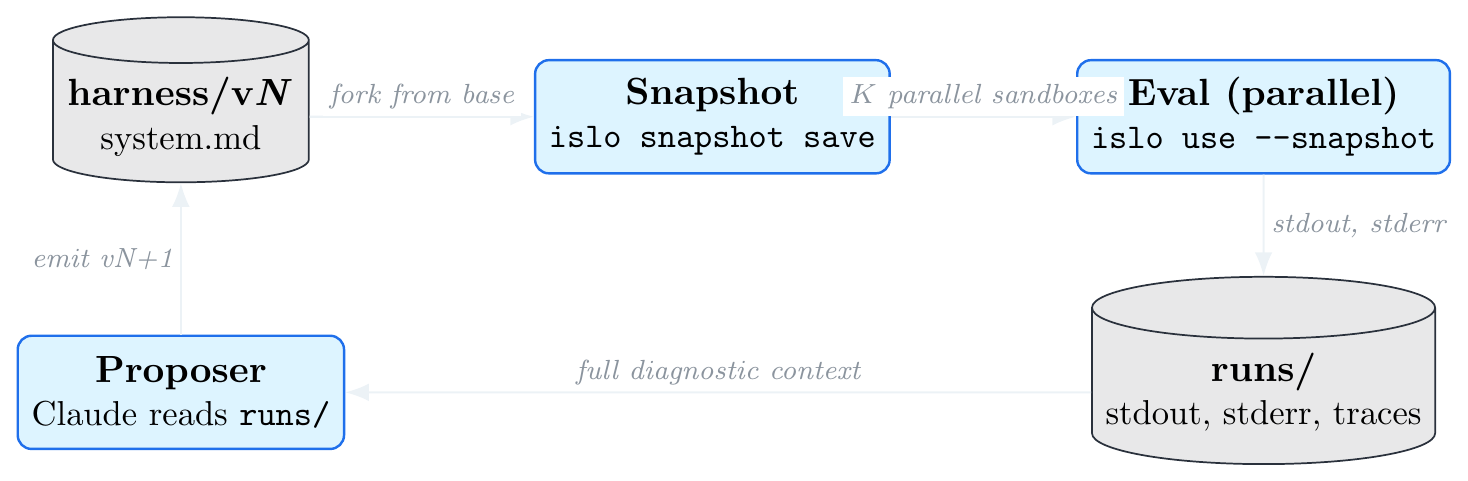
Optimization loop architecture diagram
The optimization loop, on Islo primitives. Snapshot once, fork per task, harvest traces to runs/, let the proposer read the full diagnostic context and write the next harness. Each step maps to one islo CLI primitive.
200
lines of orchestrator
5
tasks in the suite
4
proposer steps to converge
~2s
end-to-end demo

Abstract

A harness is the prompt + tools + scaffolding around an LLM agent. A meta-harness is the loop that improves the harness automatically: a proposer agent reads the diagnostic logs of prior candidates, spots a failure mode, and writes a better harness. Yoonho Lee’s framing of the idea makes one sharp claim — the bottleneck is diagnostic context: most optimizers compress prior runs into summary statistics, while meta-harness gives the proposer up to 10M tokens of raw execution traces to grep through.

That claim is only useful if the runtime can produce, store, and serve those traces cheaply. We show that Islo (docs) sandboxes already do. The key primitives map 1:1 onto what meta-harness needs: islo snapshot save for reproducible eval environments, islo use --snapshot for cheap parallel forks per candidate, and islo logs for durable diagnostic traces. We wire these together in a ~200-line bash orchestrator with a deterministic offline simulator (so the loop is observable in seconds without burning agent credits) and a pattern-matching proposer that demonstrates the optimization signal end-to-end. The same orchestrator swaps to a real Claude/Islo backend with three line changes.

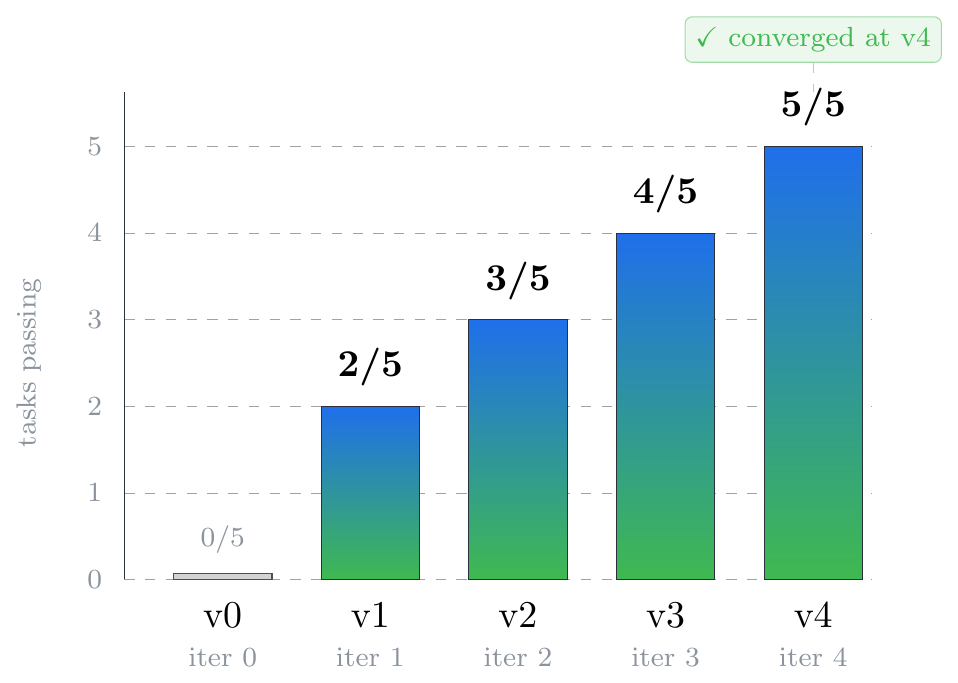
On a 5-task held-out suite (FizzBuzz, primes, list reverse, sum-of-evens, palindrome check) the loop progresses 0/5 → 2/5 → 3/5 → 4/5 → 5/5 in four proposer steps and converges, well below the 10-iteration cap. We also surface a small but illustrative result: when the proposer’s fizzbuzz hint contained the word “inclusive,” it incidentally fixed the sum-evens task too — a free transfer-fix that’s only visible because the proposer reads all traces, not summary scores.

Method

Why Islo snapshots are the missing primitive

Three things meta-harness needs from its runtime:

  1. Reproducible eval environments — every candidate harness runs against the same setup, otherwise the score is noise.
  2. Massive parallelism — testing $N$ candidates $\times K$ tasks adds up fast.
  3. Persistent traces — the proposer needs to read stdout/stderr/agent-thoughts from runs that completed an hour ago.

Islo’s primitives map 1:1:

islo snapshot save meta-base                  # prepare environment once
islo use mh-cand-7 --snapshot meta-base ...   # fork per candidate, in parallel
islo logs mh-cand-7 --type agent              # diagnostic traces, durable

Add islo gateway (deny-by-default egress to prevent reward-hacking) and --source github://owner/repo (clone the workload at boot), and the wiring is basically free. Harbor — Islo Labs’ framework for agent evaluations and RL environments — slots in as the workload spec.

The POC

tasks/        # 5 toy "SWE-style" tasks, each prompt.md + grade.sh
harness/v0/   # baseline system prompt, deliberately mediocre
bin/
  meta-harness    # bash orchestrator (eval | propose | loop | viz)
  agent-sim.py    # deterministic agent stand-in (offline mode)
  proposer.py     # reads runs/, emits harness/vN+1
viz/index.html    # live dashboard
runs/             # populated each iteration

The agent is a Python simulator that’s intentionally buggy — until the system prompt contains the right hint keyword. The loop is therefore deterministic and offline, runs in seconds, but the wiring is identical to what you’d ship against real Claude on Islo. The proposer is 80 lines: read runs/iter-N/, find which tasks failed, look up the missing hint for that task, append it to a new harness/v{N+1}/system.md. A real proposer would be:

islo use --snapshot meta-base --agent claude --task "
  Examine /workspace/runs/iter-${N}. Find a common failure mode in the
  grade.sh stderr. Write /workspace/harness/v${N+1}/system.md as a small
  edit on top of v${N}/system.md to fix it."

Same input, same output contract. The orchestrator already has the stub.
Results

Pass rate per iteration
Pass-rate per iteration. 0/5 baseline, then four monotonic improvements to 5/5. Convergence detected automatically; the loop stops below the 10-iteration cap.
Task by iteration heatmap
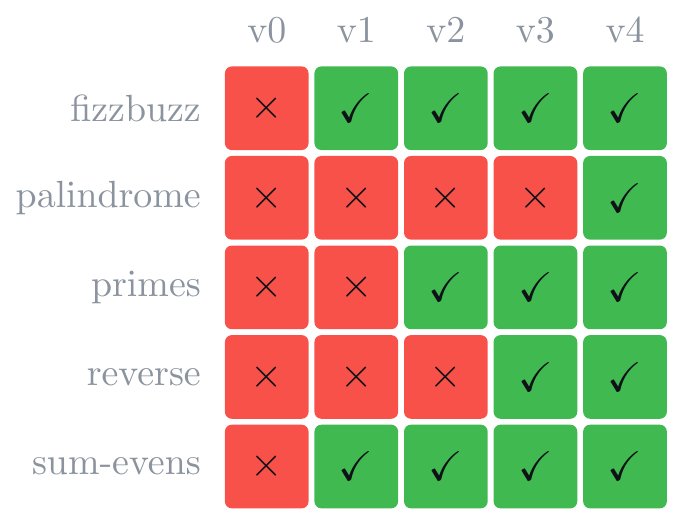
Task × iteration heatmap. The shape of the green wave shows which tasks were fixed at which step. No regressions: an earlier pass never flips back to fail.

What changed at each step

iterharnessscorewhat changed
0v00 / 5 baseline — minimal “produce only the answer” prompt
1v12 / 5 + “Loops are 1-indexed: count from 1 through N inclusive.”
2v23 / 5 + “The smallest prime is 2 — 1 is not prime.”
3v34 / 5 + “Use space-separated output for separated values.”
4v45 / 5 + “Format constraints are exact-case — lowercase only.”

A free transfer-fix

Iteration 1 is the most interesting. We added the hint targeting fizzbuzz, but the score went from 0/5 → 2/5. The bonus point came from sum-evens: that task needed the word “inclusive,” and the fizzbuzz hint contained it (“count from 1 through N inclusive”). A free transfer-fix between two tasks with overlapping vocabulary. A real proposer would either get more such accidents (good) or learn to write more general hints on purpose (also good). This is the kind of cross-trace insight you only see if the proposer can look at all the diagnostics, not summary stats.

Live dashboard

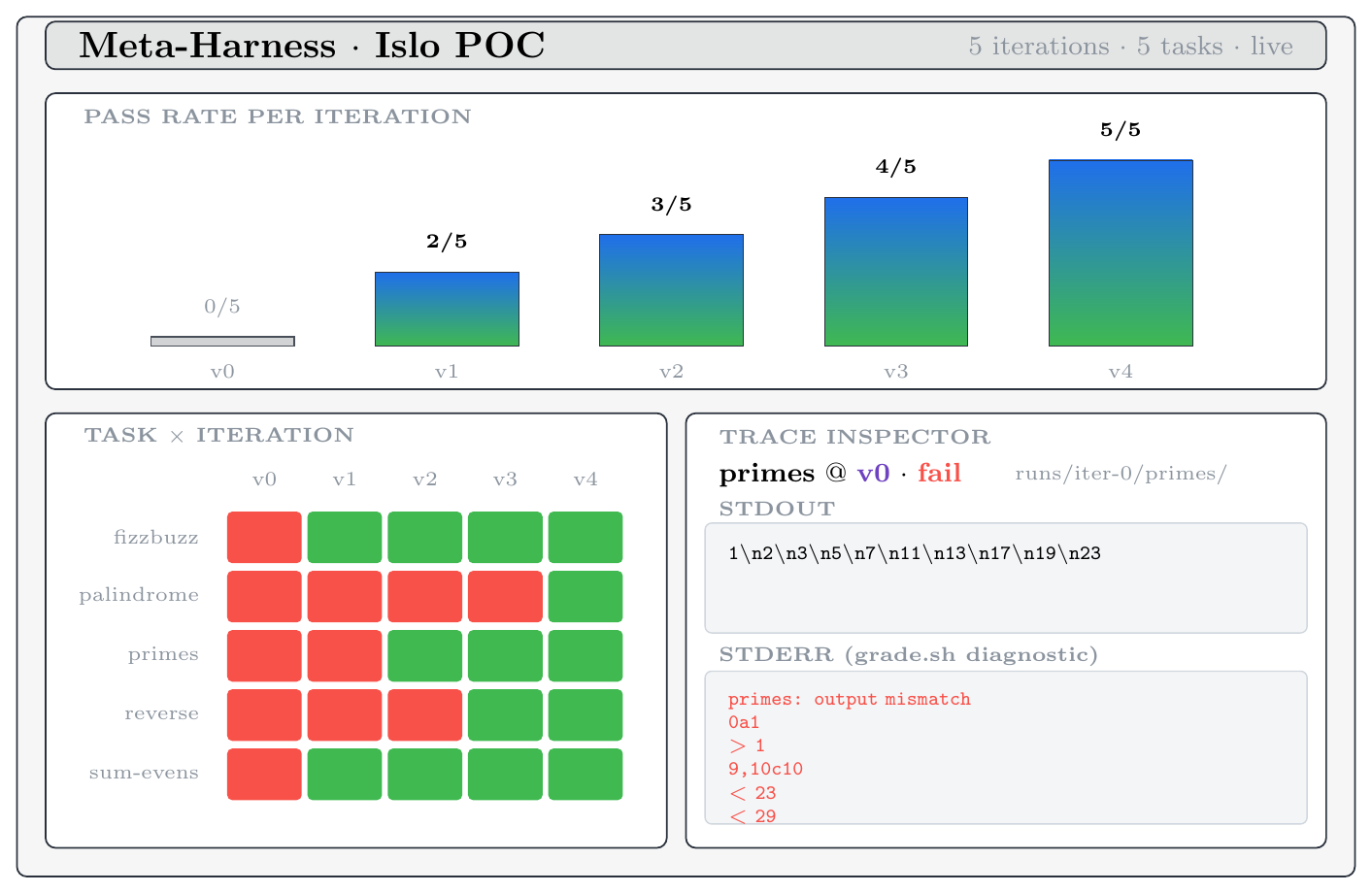
A single static HTML page (viz/index.html) polls runs/state.json every 2 seconds and shows a pass-rate timeline, a task × iteration heatmap, and a click-to-inspect trace viewer.

Dashboard layout sketch
Dashboard layout (sketch). Pass-rate timeline on top; task × iteration heatmap and trace inspector below. Clicking a heatmap cell loads that run’s stdout and the grade.sh stderr — the same diagnostic surface the proposer reads.

What this points at

This POC is intentionally tiny so the loop is observable in one screen. Three obvious next steps:

  • Real backend. Swap BACKEND=sim for BACKEND=islo. Each candidate × task becomes one islo use --snapshot meta-base call. With Islo’s parallelism that’s ~5–10s per task, end-to-end iteration in under a minute.
  • Real workload. Replace the toy tasks with Harbor or long-horizon tasks. The orchestrator doesn’t care — it only needs prompt.md + grade.sh shape.
  • Real proposer. Replace proposer.py’s pattern-match with Claude reading the full runs/ tree from inside a sandbox. This is where the 10M-token diagnostic context actually pays off — and where you’d start seeing proposed tools, not just prompt edits.

Three swaps. Same orchestrator. Same dashboard. The wiring is the thing.

BibTeX

@misc{eliaz2026metaharness,
  title  = {Meta-harness on Islo: A 200-line POC that goes from 0/5 to 5/5 in four proposer steps},
  author = {Eliaz, Yossi},
  year   = {2026},
  month  = {May},
  note   = {Code: \url{https://github.com/zozo123/meta-harness-on-islo}},
  url    = {https://zozo123.github.io/meta-harness-on-islo-page/}
}

Acknowledgements

Thanks to the meta-harness framing by Yoonho Lee, the Islo (Islo Labs) team for the sandbox infrastructure, and the Harbor framework community for the eval-spec shape this POC adopts.