01 · Partition
Plan distinct evidence
Give each worker a non-overlapping shard that measures the same target.
Evidence-Aware MapReduce for Forkable Compute
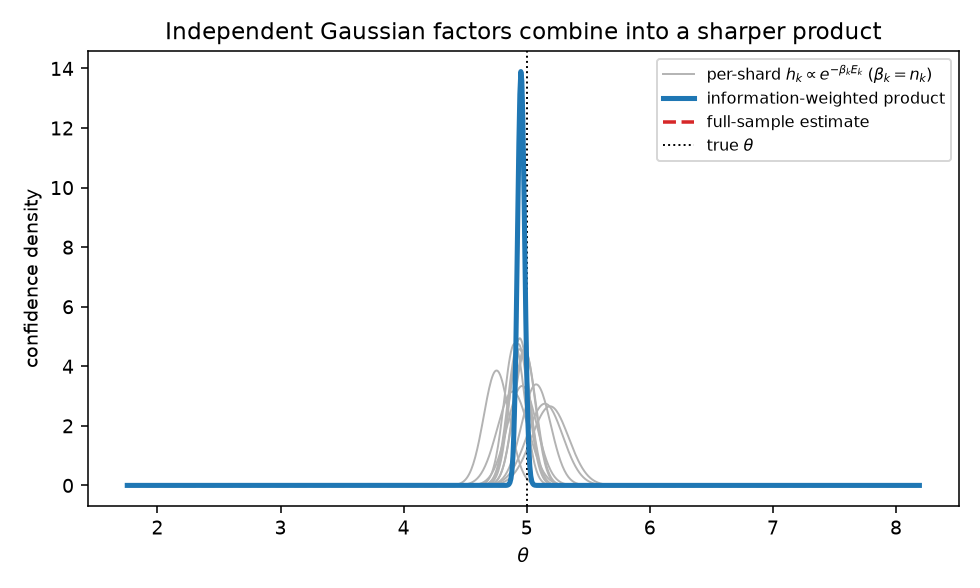
Fork workers freely. Each answer carries an estimate, its uncertainty, and where its evidence came from. Independent results then combine in proportion to the information they contain.
4.98 ± 0.10
When workers agree, the combined estimate becomes more precise and moves very little. These illustrative curves assume independent, non-overlapping evidence.
The mathematics is established inverse-information pooling. This artifact turns it into an auditable worker contract and keeps declared evidence visible at the merge.
The idea at a glance
A useful worker result says what the worker estimated, how uncertain that estimate is, and which evidence produced it. Declared identifiers expose repeated labels before they are counted twice.
Give each worker a non-overlapping shard that measures the same target.
Each worker returns its estimate, uncertainty, sample size, lineage, and evidence IDs.
Compatible Gaussian results merge by adding the small summaries P, q, and c.
Return the combined estimate, covariance, and exact disagreement energy.
Live fusion explorer
Drag the worker estimates, change their uncertainty, remove a worker, stream new samples, or reuse an evidence ID. The reducer updates immediately and stops a merge when it sees a repeated ID.
P = Σσₖ⁻² · q = ΣPₖθ̂ₖ · combined θ̂ = P⁻¹q
Why this matters
The reducer carries evidence strength, declared identity, lineage, and disagreement all the way from each worker to the combined result.
Total precision Pₖ = nₖJₖ determines each estimate's contribution to the combined result.
The compact numeric state can merge in any tree shape. Evidence IDs are sorted, while lineage keeps first-seen order.
A disagreement term records how far the workers lie from their combined estimate. Confident workers that point in different directions leave a clear signal.
Where the model applies
Combine worker summaries when they estimate the same target from independent, non-overlapping evidence. The number of workers alone says nothing about independence.
Worker summaries have a defensible uncertainty model and genuinely distinct evidence.
Workers share errors, may act adversarially, or estimate different local truths.
Auditable artifact
The tests cover the Gaussian calculation, its closed-form integral, tree-shaped merges, serialized records, repeated evidence IDs, and three deterministic statistical examples. Platform logs document the execution paths exercised so far. A controlled cross-provider benchmark remains future work.
Citation
Yossi Eliaz. “Boltzmann MapReduce: A Partition-Function Reduce for Forkable Sandboxes.” arXiv:2607.09689 [cs.AI], 2026. doi:10.48550/arXiv.2607.09689.
Version note: This citation follows arXiv v2, revised 14 July 2026. The repository PDF is the candidate next revision, titled “Evidence-Aware MapReduce for Forkable Compute: Separating Execution Fan-Out from Independent Evidence.” ArXiv will continue to show the v2 title and abstract until that revision is uploaded.
@misc{eliaz2026boltzmann,
  title         = {Boltzmann MapReduce: A Partition-Function
                   Reduce for Forkable Sandboxes},
  author        = {Yossi Eliaz},
  year          = {2026},
  eprint        = {2607.09689},
  archivePrefix = {arXiv},
  primaryClass  = {cs.AI},
  doi           = {10.48550/arXiv.2607.09689},
  url           = {https://arxiv.org/abs/2607.09689}
}
Reproduce locally
The locked workflow checks the Python package, local demos, generated figures, paper build, release PDFs, and website contract.
$ git clone https://github.com/zozo123/boltzmann-mapreduce
$ cd boltzmann-mapreduce
$ uv sync --locked
$ uv run --locked python scripts/verify_e2e.py

✓ Python · package · demos · paper · website